


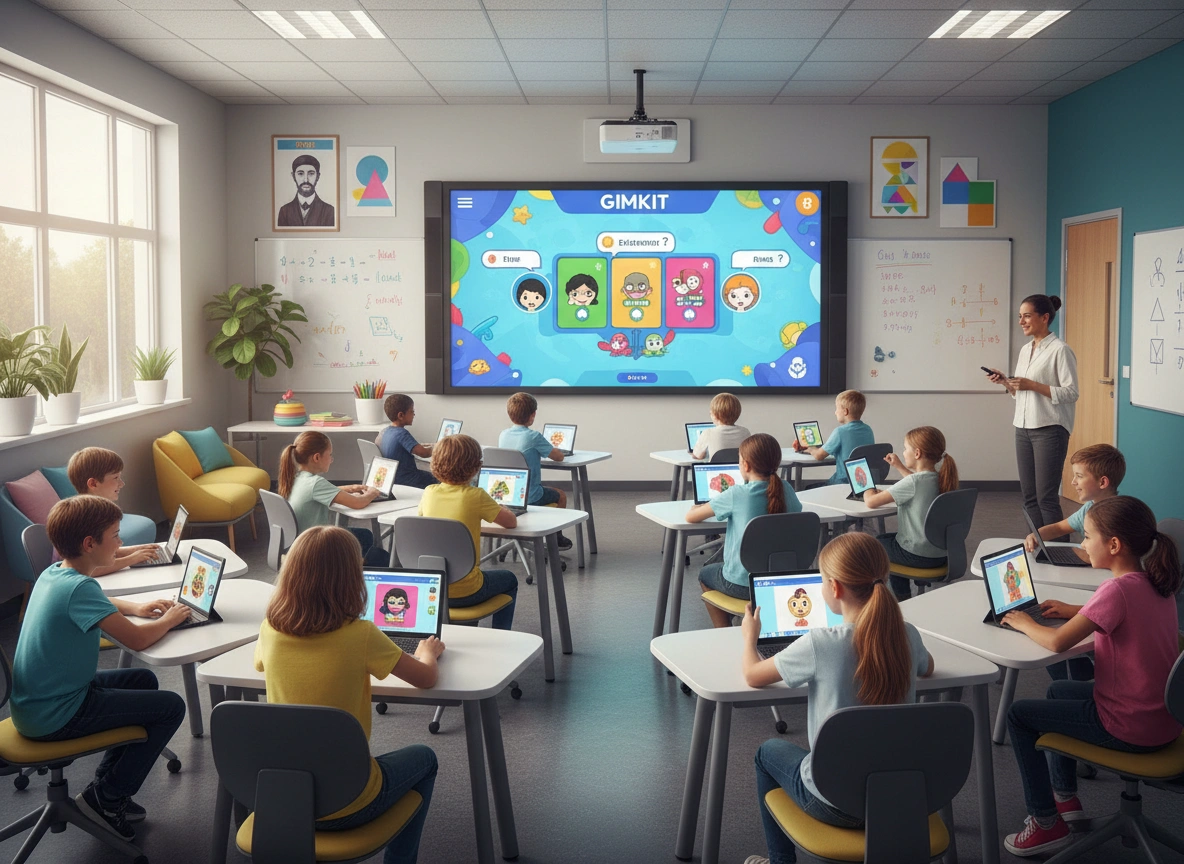
Traditional classroom review sessions often follow a predictable pattern. The teacher asks a question, a few hands shoot up (usually the same ones), and the rest of the class drifts into a daydream. It’s a challenge every educator faces: how do you make repetitive practice engaging for every student, not just the high achievers?
Enter gamification. By applying game-design elements to learning activities, educators are transforming passive review into active competition. At the forefront of this movement is Gimkit, a platform created by a high school student who experienced that classroom boredom firsthand. Gimkit isn’t just a quiz tool; it is a dynamic ecosystem where strategy, knowledge, and quick thinking converge to create deeper learning outcomes.
This article explores how Gimkit leverages gamification to boost student engagement, the specific mechanics that make it effective, and why it stands out in a crowded EdTech marketplace.
The Power of Gamification in Learning
Before diving into Gimkit specifically, we need to understand the engine that drives it. Gamification is the integration of game mechanics—like points, leaderboards, and immediate feedback—into non-game environments.
In education, this approach taps into intrinsic motivation. Students aren’t just answering questions to get a grade; they are answering to “win,” to level up, or to help their team. This shift changes the emotional context of learning. Failure becomes part of the game loop rather than a judgment of intelligence. If you get a question wrong in a game, you simply try again. This resilience is crucial for mastering difficult concepts.
Research consistently shows that gamified learning can lead to:
- Increased focus and attention spans during lessons.
- Higher retention rates due to repetitive, low-stakes practice.
- Improved social collaboration when team modes are utilized.
What is Gimkit?
Gimkit is a live learning game show application. Unlike traditional quiz tools where students simply answer questions for points, Gimkit introduces an economy. Students earn virtual “cash” by answering questions correctly. They can then reinvest this money into upgrades and power-ups to boost their earnings or hinder their opponents.
It was developed by Josh Feinsilber as a high school project. He wanted a game that he and his classmates would actually want to play. Because it was built from a student’s perspective, it avoids many of the pitfalls of “educational games” that feel like chocolate-covered broccoli. Gimkit feels like a game first and a learning tool second, which is exactly why it works.
Core Features That Drive Engagement
Gimkit’s success lies in its unique feature set. It moves beyond simple recall and introduces strategic thinking.
1. The In-Game Economy
This is the platform’s defining feature. In a standard Gimkit session (often called a “Kit”), accuracy is rewarded with currency. However, speed and strategy matter just as much. Students can visit the “Shop” to buy upgrades:
- Money Per Question: Increases the cash earned for every correct answer.
- Streak Bonus: Rewards consistency by multiplying earnings for consecutive correct answers.
- Multipliers: drastically increases the total payout.
This forces students to make economic decisions. Do I save up for a big multiplier, or do I buy smaller upgrades now? This layer of strategy keeps students engaged even if they aren’t the fastest at answering content questions.
2. Power-Ups and Sabotage
To keep the playing field dynamic, Gimkit includes power-ups. Students can buy “insurance” to protect against wrong answers or purchase “deflectors” to shield themselves from attacks. Yes, attacks. In competitive modes, students can “ice” other players (freeze their screen for a few seconds) or subtract from their earnings.
While this might sound chaotic, it mimics the excitement of video games students play at home. It adds a layer of social interaction and friendly rivalry that keeps energy levels high.
3. Repetition Without Boredom
One of the biggest hurdles in learning facts—whether it’s vocabulary, math facts, or historical dates—is the need for repetition. In Gimkit, questions repeat. Because the goal is to earn money, students actually want to see questions again so they can answer faster and earn more. They don’t view repeated questions as tedious; they view them as opportunities for profit. This leads to what educators call “overlearning,” where recall becomes automatic.
Gimkit Game Modes: Variety is Key
A major risk with any EdTech tool is novelty wearing off. Gimkit combats this with a rotating roster of game modes that completely change the objective, even while the underlying academic content remains the same.
Trust No One
Inspired by the viral game Among Us, this mode assigns students roles. Most are “Crewmates” trying to answer questions to run the ship, while one or two are “Impostors” trying to sabotage the mission. Students have to discuss, deduce, and vote out the impostors. This mode integrates critical thinking and social deduction with academic review.
The Floor is Lava
This is a cooperative mode where the class must work together. As long as students are answering questions correctly, they build structures to stay above the rising “lava.” If the class slows down or gets too many wrong answers, the lava rises. This shifts the dynamic from competition to collaboration, perfect for building class culture.
Tag
In this team-based mode, players answer questions to earn energy. They use that energy to “tag” players from opposing teams to steal their cash. It encourages teamwork and resource management, as teams must balance answering questions with aggressive gameplay.
Fishtopia
This mode turns Gimkit into a mini-RPG (Role Playing Game). Students answer questions to get bait, catch fish, and sell them. It’s a more relaxed, longer-form mode that works well for independent practice or homework assignments.
Impact on Learning Outcomes
So, is it just fun, or does it actually help students learn? The evidence from classrooms suggests the latter.
Formative Assessment in Real-Time
For teachers, Gimkit provides a robust data dashboard. At the end of a game, the teacher receives a detailed report showing exactly which questions the class struggled with and which students might need extra help. This allows for immediate intervention. A teacher can see that 60% of the class missed the question on “mitochondria” and stop the game to reteach that specific concept immediately.
Accessibility and Differentiation
Gimkit allows for differentiation without singling students out. Because the game is self-paced (students answer on their own devices at their own speed), slower readers aren’t penalized by a ticking clock on the main screen. They can take their time.
Furthermore, the “Shop” mechanic acts as a leveler. A student who might not be the strongest academically can still win by employing a smarter economic strategy than the student who knows all the answers but never upgrades their earnings. This gives every student a genuine shot at the leaderboard, boosting confidence for struggling learners.
Homework Completion
Gimkit allows teachers to assign “Kits” as homework. Instead of a worksheet, students play a mode specifically designed for asynchronous play. Teachers report significantly higher completion rates for Gimkit assignments compared to traditional homework because students are motivated to beat their own high score or finish the game loop.
Unique Aspects: How Gimkit Stands Out
The EdTech space is crowded with giants like Kahoot! and Quizizz. Why choose Gimkit?
- Student-Centric Design: Because it was built by a student, the UI and UX feel intuitive to digital natives. It speaks their language.
- High Repetition Rate: Most quiz games ask a question once. Gimkit asks it multiple times in a single session. This is superior for rote memorization tasks like vocabulary or chemical formulas.
- Dynamic Pacing: In tools like Kahoot!, the whole class waits for everyone to answer. In Gimkit, students are constantly active. There is zero downtime.
- KitCollab: This feature allows students to create the questions themselves. The teacher launches a KitCollab, students submit questions, the teacher accepts or rejects them, and then the class plays the game they just built. This empowers students to take ownership of their learning material.
Practical Examples in the Classroom
Scenario A: Foreign Language Vocabulary
A Spanish teacher wants to review food vocabulary. She launches a classic Gimkit mode. Students see the same 20 words repeated over a 10-minute session. By the end, they have seen the word “manzana” (apple) fifteen times. The association is solidified through repetition and the dopamine hit of earning virtual cash.
Scenario B: Math Fact Fluency
A 4th-grade teacher uses the “Floor is Lava” mode. The class is struggling with multiplication tables. To survive the lava, the whole class must work together. The high achievers help cheer on those who are struggling, fostering a sense of community. The pressure is on the group, not the individual.
Scenario C: History Review
A high school history teacher uses “Trust No One” to review the causes of WWI. Between rounds of answering questions, students debate who the “Impostor” is. The teacher observes that even quiet students are speaking up during the discussion phase, engaged by the social deduction element.
The Future of Gamified Education
Gimkit represents a mature phase of gamification. It isn’t just about badges or gold stars; it’s about complex systems that engage the brain’s reward centers. As we look forward, tools like Gimkit will likely become even more sophisticated.
We can expect to see deeper integration with Learning Management Systems (LMS) and perhaps AI-driven content generation that adapts the difficulty of questions in real-time based on student performance. The line between “video game” and “homework” will continue to blur.
However, the core principle will remain: engagement is the gateway to learning. You cannot teach a student who isn’t listening. Gimkit has proven that if you respect the student’s desire for autonomy, mastery, and fun, you can achieve remarkable results. It transforms the classroom from a place of passive consumption into an arena of active, strategic, and enthusiastic learning.
Conclusion
Gimkit is more than a digital distraction; it is a pedagogical tool that aligns with how modern students consume information. By prioritizing engagement through game mechanics, an in-game economy, and diverse play modes, it solves the age-old problem of making review interesting.
For educators looking to revitalize their classroom dynamic, Gimkit offers a low-barrier, high-impact solution. It respects the teacher’s need for data and the student’s desire for fun. In the evolving landscape of education, tools that can bridge that gap are not just useful—they are essential.
Next Steps for Educators
- Create a Free Account: Visit Gimkit.com and sign up. The basic version is free and robust enough to start.
- Import Existing Sets: You don’t need to start from scratch. You can import question sets from Quizlet or a spreadsheet.
- Start Simple: Run a “Classic” mode first to let students understand the economy mechanic before trying complex modes like “Trust No One.”
- Use KitCollab: For your next review, have the students write the questions. It saves you prep time and forces them to think critically about the material.
Please visit the official site for more info.
